Article: Framed vs Frameless Bathroom Mirrors: Which Looks Better?
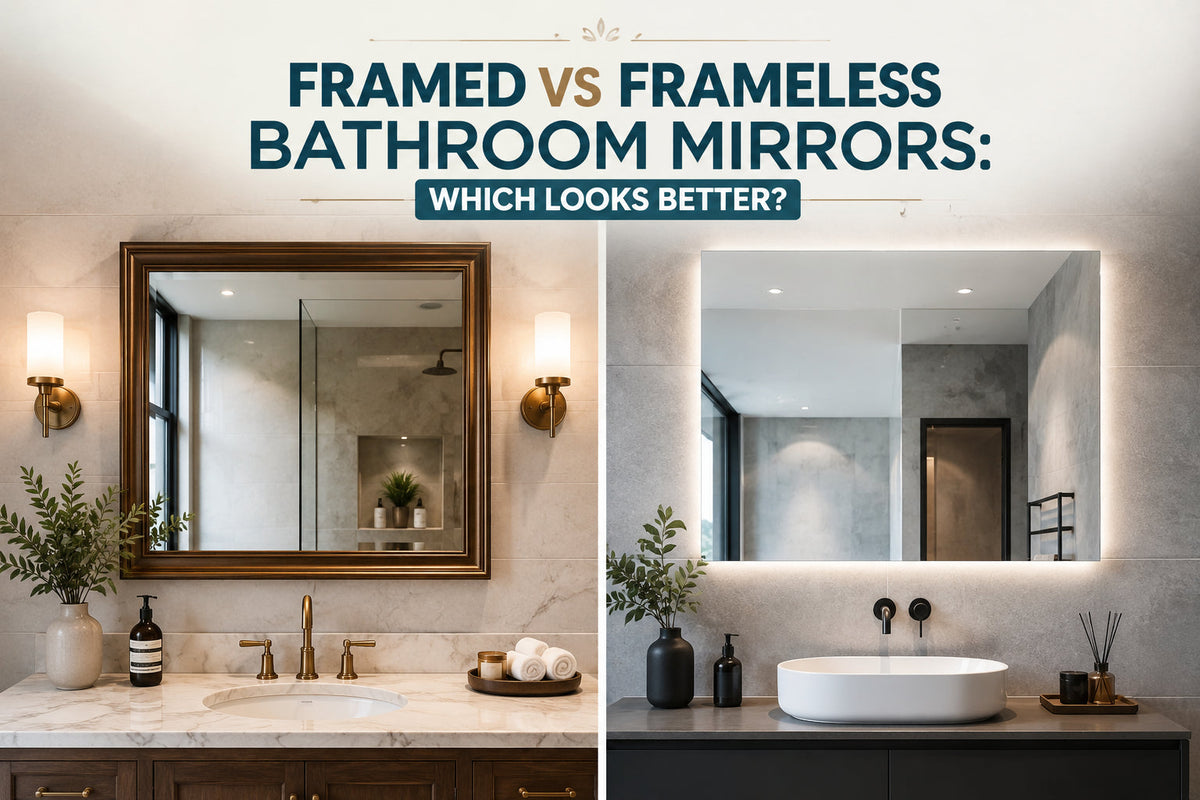
Framed vs Frameless Bathroom Mirrors: Which Looks Better?
You can have the perfect vanity, tapware and tiles and still feel something is off. Often it's the mirror. It sits at eye level, it's the first thing you see when you walk in, and it either ties the room together or quietly lets it down. So, framed v frameless bathroom mirrors: which looks better? Here's the short answer. A frameless mirror looks better in modern, compact or tile-heavy bathrooms where you want the room to feel open. A framed mirror looks better when the bathroom needs warmth, contrast or a finish that echoes your tapware. This guide helps you decide, with real-world detail on style, size, lighting, cost and care.
Which Looks Better?
- Choose frameless if your bathroom is small, modern, minimalist or covered in feature tile.
- Choose framed if your walls and vanity feel plain, or you want to repeat a finish like matte black or brushed brass.
- Choose a slim frame or a bevelled edge if you can't decide. Both are covered below.
Neither is the "right" answer for every bathroom. The right one is the one that suits your vanity, your light and your wall space.
Framed vs Frameless Bathroom Mirrors at a Glance
| Framed mirror | Frameless mirror | |
|---|---|---|
| Overall look | Defined, decorative, furniture-like | Clean, open, understated |
| Best for | Traditional, Hamptons, industrial, transitional | Modern, minimalist, spa-style, small bathrooms |
| Visual effect | Adds contrast and a focal point | Lets tile, vanity and lighting lead |
| Cleaning | Glass plus frame edges and corners | One flat glass surface |
| Moisture risk | Depends on frame material and finish | Exposed edges need ventilation and care |
| Sizing | Often standard sizes | Easy to make wide, tall or custom |
| Lighting | Great with side sconces | Great with built-in LED lighting |
What Is a Framed Bathroom Mirror?
A framed bathroom mirror has a visible border around the glass. That border can be aluminium, stainless steel, timber, resin or another moisture-resistant material. It might be a thin black line or a chunky statement piece.
Pros
- Adds personality to a plain wall without changing tiles or cabinetry
- Creates a strong anchor above a large vanity
- Lets you repeat a finish, such as matte black or brushed brass, from your tapware or hardware
- Protects the glass edges from knocks
- Helps define two sink zones on a double vanity
Cons
- The frame takes up wall space and can make a narrow reflection feel smaller
- Low-quality or unsealed frames can swell, peel or rust in humidity
- Dust settles on the top edge and residue builds where frame meets glass
- A very bold frame can date faster than plain glass
What Is a Frameless Bathroom Mirror?
A frameless mirror has no border. Instead, the edge is polished flat, or bevelled so the glass tapers slightly and catches the light. It can be a simple rectangle, an arch, an oval or a custom panel that runs the full width of your vanity.
Pros
- Looks light, calm and uncluttered
- Reflects more light, which helps small bathrooms feel bigger
- Wipes clean quickly with no frame corners
- Easy to make wide for a double vanity or cut around sconces and outlets
- Pairs well with LED lighting
Cons
- Can look too plain in a bathroom that is already minimal
- Exposed edges are more vulnerable to chips and, over time, moisture creeping into the backing
- Needs careful, level installation
- Shows fingerprints quickly if it's touched often

Framed vs Frameless Bathroom Mirrors: Which Looks Better in Your Style of Bathroom?
This is where most guides stop at "it depends." Here's a more direct take, by bathroom style.
Modern or minimalist. Frameless wins. Clean lines suit a plain mirror, and it won't compete with a wall-hung vanity or large-format tiles.
Hamptons or coastal. A slim framed mirror in white, timber or brushed nickel suits the soft, layered look. A very thin frame is better than a heavy one.
Industrial. A matte black or gunmetal frame picks up black tapware and gives the wall a strong outline.
Traditional or classic. A framed mirror, ideally with a timber or brass-toned finish, adds the warmth this style needs.
Luxe or hotel-style. A large frameless or backlit mirror over a wide vanity feels like a hotel suite.
Feature tile or patterned walls. Go frameless. The tile is already the star, and a frame adds one more thing to look at.
Match Your Mirror to Your Tapware, Vanity and Tiles
Think of the mirror as part of the vanity wall, not a separate purchase.
- Match loosely, not exactly. Repeating a finish once or twice is enough. If your tapware is matte black, a matte black frame looks intentional. Matching every item can look forced.
- Mixed finishes? A frameless mirror is more forgiving. It adds no new colour to the mix.
- Warm vanity (timber or plywood)? A brushed brass or timber-toned frame leans into the warmth. A frameless mirror keeps it calm.
- Cool, white or stone surfaces? A black or gunmetal frame adds contrast. Frameless keeps it crisp.
If you're choosing finishes at the same time, browse matte black, brushed brass, brushed nickel and gunmetal ranges together so the whole vanity wall works as a set. Your tile choice matters too, and our guide to large vs small bathroom tiles can help you decide what sits behind the glass.

Which Is Better for a Small Bathroom?
Frameless usually has the edge in a small bathroom. With no border to break up the reflection, the wall looks wider and brighter, and the mirror bounces more light around the room.
That doesn't rule out a frame. If you love the look, keep the profile slim and leave a little wall space around it. A thick, dark or ornate frame can feel heavy when the vanity is close to the side walls. In a large bathroom, either style works. Framed mirrors help divide two sinks, and one long frameless mirror gives a quieter look across a double vanity.
Lighting: Where the Mirror Style Really Matters
Lighting changes which mirror looks better more than most people expect.
- Side sconces: A framed mirror sits neatly between them, and the frame gives the arrangement a tidy, structured look.
- Built-in LED: Frameless mirrors suit integrated lighting, which gives a seamless, glowing surface.
- Front-lit vs backlit: Front-lit mirrors light your face for grooming and makeup. Backlit mirrors add a soft halo effect on the wall.
- Framed LED mirrors: These exist too, and they're a good middle ground. For example, our aluminium-framed arch LED mirror in gunmetal grey combines a defined frame with hidden front lighting.
Many LED mirrors also offer touch sensors, adjustable colour temperature and demister pads. Browse the full range of LED mirrors to see what's available.
A note on safety. In Australia, hardwired lighting in a bathroom needs to be installed by a licensed electrician, and bathroom electrical zones and IP ratings matter. Check the product's rating and the current wiring rules (see Standards Australia) before you buy.

Cleaning and Maintenance
Frameless mirrors are quicker to clean. There's one open sheet of glass and no corners to dust. Framed mirrors need a little more attention because dust sits on the top edge and moisture can collect where the frame meets the glass.
A few habits help either type last longer:
- Spray cleaner onto a microfiber cloth, not directly onto the mirror.
- Wipe top to bottom in light, overlapping strokes.
- Dry metal frames straight away, and use only a barely damp cloth on timber frames.
- Never let water or cleaner pool along the bottom edge or seep behind the glass.
- Run the exhaust fan during and after showers.
Neither style is maintenance-free in a steamy bathroom, but good ventilation does most of the work.
Durability and Humidity
Framed mirrors protect the edges of the glass, which can be handy in a busy family bathroom. But the frame itself must handle humidity. Aluminium, stainless steel and well-sealed or powder-coated finishes are safer choices than unfinished timber.
Frameless mirrors have no frame to rust or warp, but their exposed edges need protection from constant moisture. Quality backing and correct installation matter. If you see dark spots creeping in from the edge, moisture may have reached the backing layer. Choosing a polished or bevelled edge and keeping the area ventilated reduces that risk.
How Big Should a Bathroom Mirror Be?
A simple rule of thumb: keep the mirror a little narrower than the vanity, or match its width for a clean, built-in look. A mirror much wider than the vanity can look oversized, and one much narrower can look lost.
- Single basin: The mirror can be about the same width as the vanity, or slightly narrower.
- Double vanity: Use two separate mirrors (framed ones suit this well) or one long frameless mirror for a continuous look.
- Height: Hang it so the centre sits around eye level for the people using it, with a small gap above the tap or backsplash.
- Custom sizes: Frameless mirrors are easier to cut to size, which helps around sconces, outlets or unusual tile lines.
If you're still choosing the vanity, look at wall-hung vanities and narrow vanities first, then size the mirror to suit. That order tends to make the decision easier.
How Much Do Framed and Frameless Mirrors Cost?
Prices vary widely by size, brand and features, so use these as a rough guide only.
- Plain frameless mirrors are often the lowest-priced option, but custom sizes, bevelled edges or special shapes can raise the cost.
- Framed mirrors range from affordable manufactured frames to premium metal or solid-timber designs.
- LED mirrors cost more than plain glass in either style. Our gunmetal framed arch LED mirror, for instance, is listed at $579.
Don't forget the extras: mounting hardware, wiring, and installation by a professional. Set your budget first, then compare both styles within it. Browse all mirrors, wall mirrors or mirror cabinets to see current prices.
Installation: Get It Right the First Time
A mirror is only as good as the way it's mounted.
- Check the weight and your wall type (plasterboard, tile or masonry) before choosing fixings.
- Use hardware and adhesive made for mirrors, and follow the manufacturer's instructions.
- Make sure the wall is flat and level. A tilted frameless mirror is more obvious than a tilted framed one.
- Drilling into tile needs care. Our guide to installing bathroom accessories on tiles without cracking them covers the technique.
- For large mirrors, hardwired LED mirrors, or mirrors close to a sink, hire a professional.
The Middle Ground: Slim Frames, Bevelled Edges and Mirror Cabinets
You don't have to pick a side completely.
- Slim frames add definition without bulk, and work in small bathrooms.
- Bevelled or polished-edge frameless mirrors give a soft, refined outline without a visible frame.
- Mirror cabinets add hidden storage behind a mirrored door, which helps in compact rooms. See our mirror cabinets.
- Arch and round mirrors can be framed or frameless, and soften a bathroom full of straight lines.
5 Mistakes to Avoid When Choosing a Bathroom Mirror
- Buying before choosing the vanity and lighting. The mirror should be the last big decision, not the first.
- Picking a frame that clashes with your finishes. Check it against your tapware and hardware.
- Ignoring ventilation. Poor airflow shortens the life of both framed and frameless mirrors.
- Choosing the wrong size. Measure the vanity wall, and allow for sconces and outlets.
- Skipping professional installation for large or hardwired mirrors.
Conclusion
When it comes to framed v frameless bathroom mirrors, which looks better depends on the room you're actually standing in. A frameless mirror keeps things light, open and easy to clean. A framed mirror adds warmth, contrast and a finish that ties the vanity together. Look at your vanity, tapware, tiles and lighting first, then let the mirror finish the job.
Ready to compare? Browse our full range of bathroom mirrors at Living and Bathroom and find the one that suits your space.
Frequently Asked Questions
Is a framed or frameless bathroom mirror better?
Neither is better for every bathroom. Choose framed for contrast and decorative detail, and frameless for a clean, open look.
Do frameless mirrors make a bathroom look bigger?
They can. With no frame interrupting the reflection, a wide frameless mirror bounces light around and makes a small vanity wall feel more open.
Are framed mirrors harder to clean?
Slightly. Dust and moisture can collect around the frame edges, but the glass is cleaned the same way as a frameless mirror.
What frame material is best for a humid bathroom?
Aluminium, stainless steel and well-sealed or powder-coated finishes are practical choices. Avoid unfinished timber, especially with poor ventilation.
Can I have an LED mirror with a frame?
Yes. Framed LED mirrors work well with front lighting, and you can pair them with side sconces if the frame doesn't block the light.
How high should I hang a bathroom mirror?
Aim for the centre of the mirror to sit near eye level for the people using it, leaving a small gap above the tap or backsplash.
Do I need an electrician to install an LED mirror?
For hardwired mirrors in Australia, yes. A licensed electrician should install them. Plug-in styles are simpler, but still check the product's rating for bathroom use.