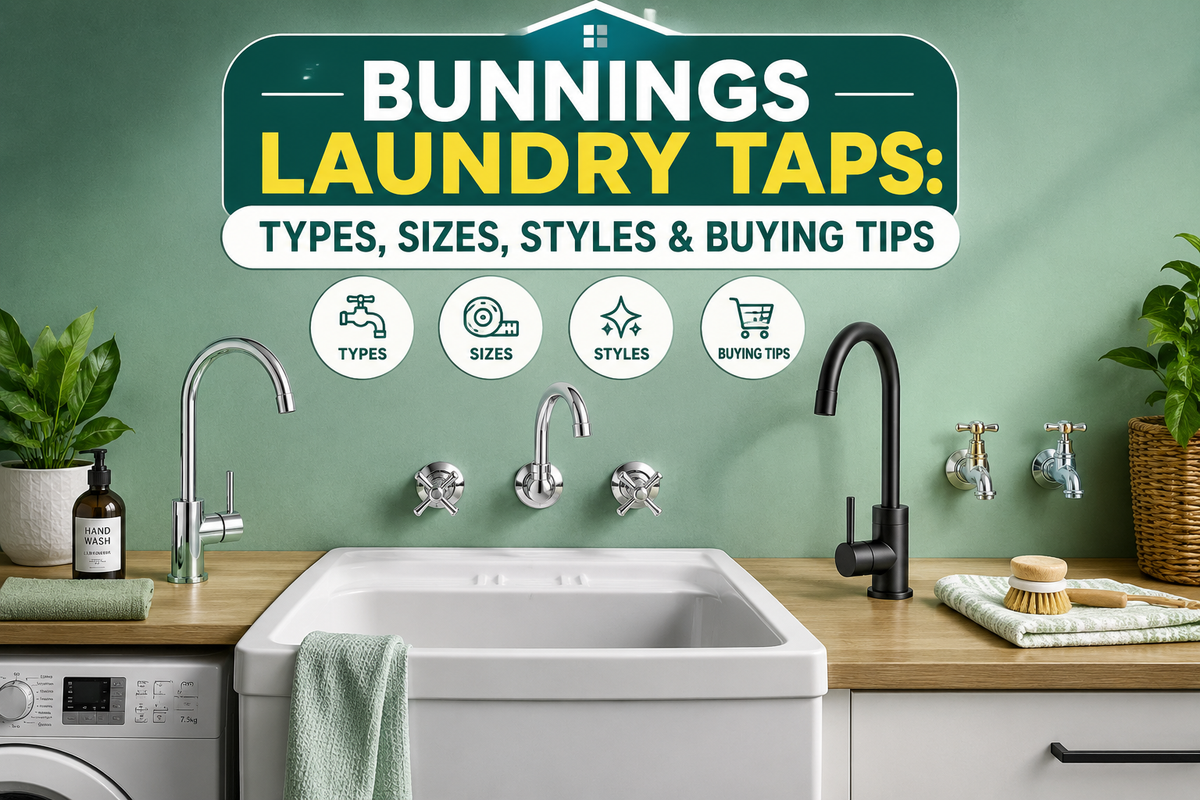
Bunnings Laundry Taps: Types, Sizes, Styles & Buying Tips
If you're shopping for Bunnings laundry taps, the choice looks simple until you're standing in the aisle realising you don't know whether your old tap is a wall-mounted mixer or a wall-top assembly, or whether the new one will even cover the holes in your splashback. This guide is for anyone replacing tired laundry tapware or fitting out a new laundry tradies excluded, this is written for the person doing the research before they buy. We'll walk through the types of laundry taps and mixer taps you'll come across, how sizing actually works, the styles worth considering, and the buying mistakes that catch people out most often.
What Are Laundry Taps?
A laundry typically needs two separate pieces of tapware: one over the sink or tub for hand-washing and general use, and a dedicated set of washing machine taps that feed the machine itself. They're not interchangeable, and it's a common mix-up a tap rated for a sink isn't built for the constant on/off cycling a washing machine puts it through.
Laundry taps are either wall-mounted (the plumbing sits behind the wall, tap body and handle sit in front) or bench/sink-mounted (the tap comes up through the sink or benchtop itself). Which one you need usually isn't a style decision it's dictated by whatever plumbing is already in your wall or bench, unless you're starting from scratch.

Laundry Taps vs Washing Machine Taps
The tap over your tub handles hand-washing, rinsing, filling buckets anything manual. Washing machine taps are a separate stop-and-connect fitting, usually a pair (hot and cold) mounted low near the machine, built to sit under constant pressure with the valve closed for weeks at a time. If you're only replacing one, check first which one is actually leaking it's an easy detail to get wrong when ordering.

Types of Bunnings Laundry Taps
Laundry mixer taps use a single handle to blend hot and cold water, so you set temperature and flow with one hand. They're the most common choice in newer laundries because they're compact and easy to use one-handed while you're holding washing.
Separate hot and cold taps give you two handles, each controlling one water line. They're a straightforward, traditional setup and often the simpler swap if you're replacing an existing separate set you're not changing the number of holes or the plumbing configuration.
Wall-mounted laundry taps are fixed straight to the wall above the tub, keeping the bench or sink surface completely clear. This is the standard layout in older laundries and most townhouse or apartment set-ups.
Bench or sink-mounted taps come up through the sink or benchtop itself, which gives a cleaner, more contemporary look but only works if your sink already has (or can have) the right mounting holes.
Washing machine taps are their own category a low-mounted stop valve pair, not a display piece. Don't confuse a decorative laundry mixer with these; they're built and tested differently.
Swivel, pull-out and flexible spout taps add reach so you can rinse the far corners of a deep tub, fill a mop bucket, or wash something oversized without repositioning it. Worth considering if your laundry sink doubles as a general utility sink.
Common Laundry Tap Sizes
There's no single "standard" laundry tap size the right one depends on your existing plumbing and your sink or tub. Here's what actually matters when you're measuring:
| Measurement | Why It Matters |
|---|---|
| Tap height | Clearance above the tub too short and buckets won't fit under it |
| Spout reach | Where the water actually lands in the sink |
| Mounting hole size | Whether the tap physically fits your bench or sink |
| Connection size | Has to match your existing water supply fittings |
| Centre-to-centre distance | Critical for separate hot/cold tap sets to line up |
What Size Laundry Tap Do I Need?
Before you buy, measure: the existing tap holes, the distance between hot and cold outlets (if you have separate taps), how far the spout needs to reach over the sink, and the clearance height above your tub. If your current tapware is wall-mounted, also check the wall plumbing hasn't moved — replacing like-for-like is far simpler than switching mounting types.
Plumbing terminology trips a lot of people up here you don't need to know what "15mm" or a thread size means to shop confidently, but it's worth bringing a photo of your existing tap (or the old tap itself) when you go in-store, so you're matching fittings rather than guessing from a spec sheet.
Popular Laundry Tap Styles
Chrome remains the safest, most coordinated choice it suits both older and newer laundries and is the easiest finish to match if you're not renovating the whole room at once.
Matte black gives a laundry a more contemporary, grounded look and pairs well with dark cabinetry or hardware it's also fairly forgiving of fingerprints and water marks compared to polished finishes.
Brushed nickel and brushed finishes offer a softer, less reflective alternative to chrome, useful if you're coordinating tapware across the laundry, kitchen and bathroom.
Stainless steel styles suit laundries with a stainless tub, giving a consistent, practical, low-maintenance look.
Traditional tapware with separate handles and classic styling suits heritage homes or laundries where you're not changing the overall aesthetic, just refreshing worn fittings.
How to Choose Bunnings Laundry Taps
1. Check your existing plumbing. Wall-mounted and bench-mounted taps aren't interchangeable without plumbing work, so confirm which one you currently have before shopping.
2. Measure before you buy. Hole diameter, outlet spacing, spout reach, tap height and connection size get these down on paper, not from memory.
3. Match spout height to your sink. A taller spout gives useful clearance for filling buckets, but if it's too tall for a shallow sink, you'll get more splash, not less.
4. Consider your water pressure. Some tap designs, particularly pull-out or flexible-hose spouts, perform better under consistent mains pressure worth checking if your home has known low-pressure issues.
5. Check the WELS rating. Australia's Water Efficiency Labelling and Standards scheme rates tapware out of six stars for water efficiency, and the rating (plus the flow rate in litres per minute) has to be displayed on the tap. More stars generally means lower water use per minute.
6. Choose a finish that suits the room, not just what's on sale chrome, matte black, brushed nickel and stainless all wear differently over time.
7. Think about cleaning. Simpler shapes with fewer crevices are easier to keep looking new in a room that sees a lot of detergent and hard water spotting.
8. Check the warranty and what's replaceable. Cartridge type, body material and whether replacement parts are available matter more for a fitting that gets used daily.

Mixer Tap vs Separate Hot and Cold Taps
| Feature | Mixer Tap | Separate Hot & Cold |
|---|---|---|
| Temperature control | Single handle | Two separate handles |
| Look | Modern | Traditional |
| Operation | One-handed | Two-handed |
| Space needed | Compact | Usually more room |
| Easiest to replace | Only if matching an existing mixer | Often simpler if matching existing separate outlets |
| Best suited to | Contemporary laundries | Traditional layouts or straight swaps |
Neither is objectively "better" a mixer suits a modern, space-conscious laundry, while separate taps are often the path of least resistance if you're replacing like-for-like without touching the plumbing.
Common Mistakes When Buying Laundry Taps
- Buying without measuring — the single biggest cause of a tap that arrives home and doesn't fit.
- Choosing the wrong mounting type — wall-mounted and bench-mounted aren't interchangeable without renovation work.
- Ignoring spout reach — too short, and water misses the sink; too long, and it splashes.
- Forgetting water pressure — some spout styles need consistent pressure to perform properly.
- Matching only on finish — a great-looking tap that doesn't fit your plumbing is still the wrong tap.
- Confusing washing machine taps with sink taps — they're built for different jobs and aren't interchangeable.
- Ignoring WELS information — it affects both water bills and, in some states, compliance for renovations.
- Assuming one tap fits every tub — always check the sink or tub's mounting holes against the tap's specs.
How Much Do Laundry Taps Cost?
Rather than quoting prices that go stale, it's more useful to know what drives the cost: whether it's a basic or premium range, mixer vs separate handles, finish (matte black and brushed finishes usually cost more than chrome), brand, cartridge quality, added features like pull-out spouts, and installation if you're using a licensed plumber.
Are Bunnings Laundry Taps Suitable for Your Laundry?
There's no universal answer it comes down to your existing plumbing, your tub or sink style, available space, water pressure, the look you're going for, your budget, and whether installation is DIY or needs a plumber. Working through the checklist above before you shop will tell you more than any single "best" recommendation.
Final Buying Checklist
Before buying laundry taps, check:
- Mounting type
- Existing hole size
- Connection size
- Spout reach
- Tap height
- Water pressure
- WELS rating
- Finish Warranty
- Installation requirements
Ready to browse? See our full range of laundry tapware and laundry sinks, or shop by finish in chrome, matte black or brushed nickel.
Frequently Asked Questions
What size taps do I need for a laundry sink?
There's no single standard size measure your existing hole spacing, connection size and spout reach before buying.
Are laundry taps standard size?
No. Sizing varies by brand and style, which is why measuring your current setup matters more than assuming compatibility.
Can I replace old taps with a mixer?
Yes, but if you're switching from separate hot/cold to a mixer, you may need to change the number of mounting holes or the plumbing configuration check before you commit.
What are the different types of laundry taps?
Mixer taps, separate hot and cold taps, wall-mounted taps, bench-mounted taps, washing machine taps, and swivel/pull-out spout taps.
Are laundry taps WELS rated?
Most tapware sold in Australia falls under the WELS scheme and must display a star rating and flow rate.
What's the difference between laundry taps and washing machine taps?
Laundry taps sit over the sink or tub for general use; washing machine taps are a dedicated stop-and-connect fitting that feeds the machine.
Can laundry taps be wall mounted?
Yes it's the most common configuration in older laundries, with the plumbing set into the wall behind the tap.
Do I need a plumber to install laundry taps?
For anything beyond a straight like-for-like swap, a licensed plumber is recommended, both for safety and to keep any product warranty valid.